Movement Leadership Indicators Assessment
Co-created with youth organizers and seasoned movement leaders.
The new standard for measuring civic leadership.
The Movement Leadership Indicators (MLI) is a leadership development framework designed to help folks see themselves more clearly as a leader. It’s an assessment focused on leaders think about who they are, and how that shows up in what they do.
This assessment is rooted in decades of evidence-based research on leadership development and organized around five domains:
Confidence & Identity
Emotional Intelligence & Relational Leadership
Agency & Action Orientation
Resilience & Adaptive Capacity
Sustainable Leadership & Collective Wellbeing
The purpose of this assessment is to help identify where leaders are already strong and where there’s room to grow, and to give PLIEF’s team of professional coaches a clear, detailed starting picture of leadership so they can tailor the coaching journey to what will actually help leaders reach your full leadership potential.
Learn more about the Five Leadership Domains
-
Leadership confidence develops through a progression from self-awareness and participation toward ownership, delegation, and the active development of others.
Early growth focuses on helping participants identify limiting beliefs, clarify their leadership identity, and practice communication and feedback skills. Over time, leaders begin to internalize leadership as a relational and developmental practice rather than simply individual performance.
-
Growth in emotional intelligence centers on moving from reactive, individually-centered leadership toward relational awareness, empathy, and collective stewardship.
Participants increasingly learn to regulate emotions, navigate difficult interpersonal dynamics, and intentionally cultivate trust, curiosity, and vulnerability. Over time, relational practices evolve into stable leadership habits that improve team cohesion and organizational culture.
-
Growth in agency focuses on helping participants move from hesitation, over-planning, or dependency toward initiative, execution, and strategic leadership.
Early coaching supports confidence in experimentation and action despite uncertainty. Later growth emphasizes accountability, delegation, and systems-level thinking.
-
Growth in resilience reflects a movement from rigidity, discouragement, or fixation toward adaptability, reflection, and sustained forward momentum.
Participants increasingly reframe setbacks as opportunities for learning rather than evidence of failure. Coaching supports both emotional recovery and strategic adaptation.
-
Growth in sustainable leadership centers on moving from burnout, overextension, and martyrdom toward long-term sustainability, boundary-setting, and collective care.
Participants increasingly recognize that leadership effectiveness depends on personal well-being, sustainable practices, and organizational cultures that support rest, joy, and reflection.
Across all five domains, growth follows a consistent pattern
Early Coaching Sessions
Growth is primarily:
Internal
Reflective
Experimental
Practice-oriented
Participants begin:
Naming patterns
Developing self-awareness
Building intentional habits
Testing new behaviors
Reframing individual leadership assumptions
Later Coaching Sessions
Growth becomes:
Relational
Organizational
Integrated
Systems-oriented
Participants increasingly:
Transfer personal learning into organizational practice
Build structures that support others
Normalize healthier leadership behaviors
Address root causes rather than symptoms
Develop cultures, not just individual habits
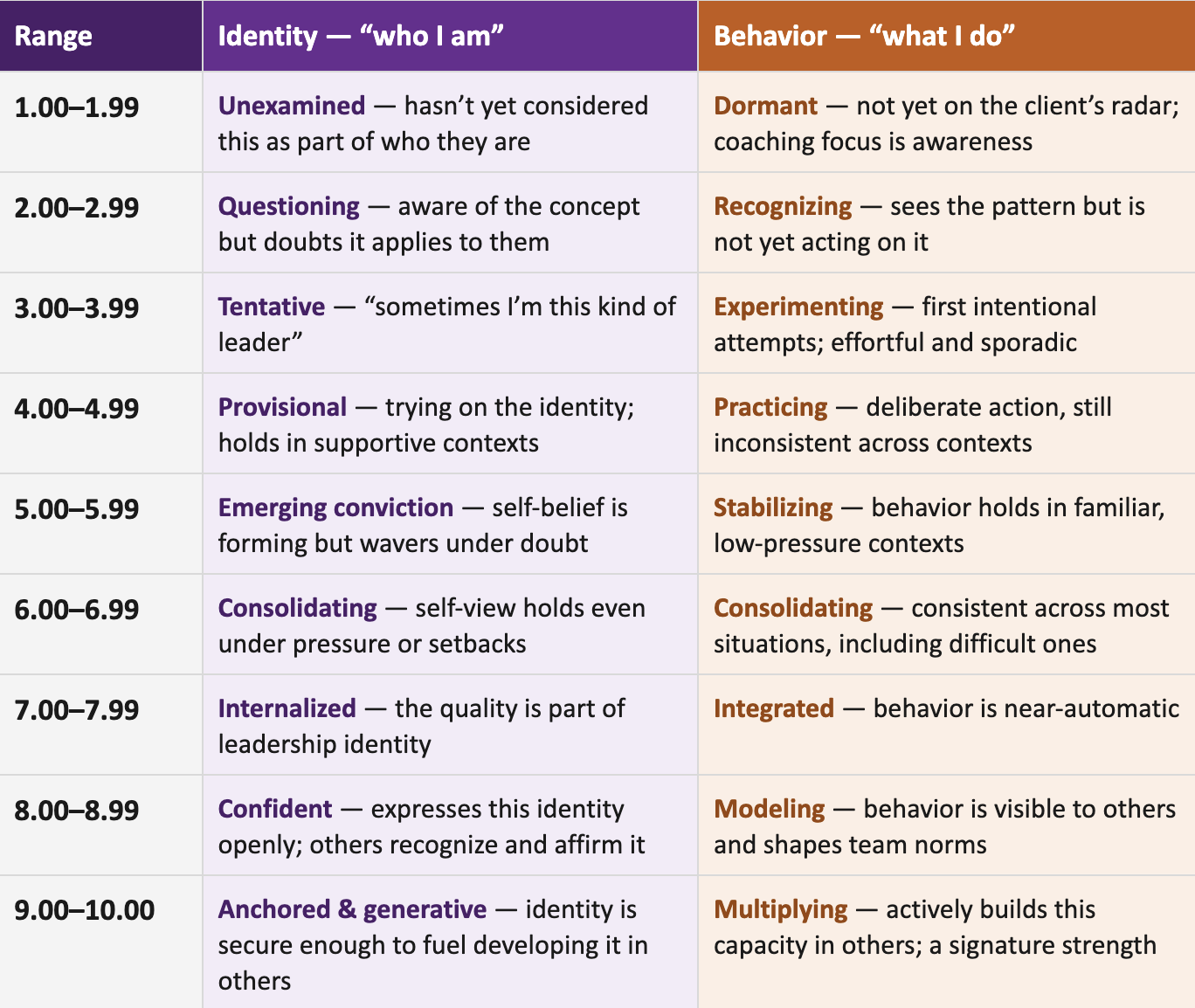
Our Scale of Leadership Growth